Search


 Open Access
 84846785@qq.com
Evidence-based care significantly reduces the incidence of lower-limb thrombosis and overall postoperative complications in hip arthroplasty patients.
This care model effectively alleviates anxiety and depression, enhancing patients' psychological well-being during recovery.
Patients receiving evidence-based care show improved quality of life, greater independence in daily activities, and higher nursing satisfaction.
Open Access84846785@qq.comEvidence-based care significantly reduces the incidence of lower-limb thrombosis and overall postoperative complications in hip arthroplasty patients.
This care model effectively alleviates anxiety and depression, enhancing patients' psychological well-being during recovery.
Patients receiving evidence-based care show improved quality of life, greater independence in daily activities, and higher nursing satisfaction.
Objective: To explore the effect of evidence-based care on lower-limb thrombosis and negative emotions following hip arthroplasty. Methods: A total of 108 patients undergoing hip arthroplasty at our hospital were randomly assigned to the observation group (n=54, evidence-based care) and the control group (n=54, conventional care). Postoperative complications, negative emotions, quality of life, activities of daily living, and patient satisfaction were compared between the two groups. Results: The observation group had a lower incidence of lower-limb thrombosis and overall complications, as well as higher patient satisfaction than the control group (all P<0.05). One month after discharge, patients in the observation group showed significantly lower scores on the Hamilton Anxiety Scale, the Hamilton Depression Scale, and activities of daily living scale, but with increased Generic Quality of Life Inventory-74 scores, compared with before intervention (all P<0.05). Conclusion: Evidence-based care significantly relieves anxiety and depression, reduces the incidence of lower-limb thrombosis, and improves quality of life in patients after hip arthroplasty.
Keywords: Evidence-based care, hip arthroplasty, lower-limb thrombosis, negative emotion
Hip arthroplasty is the primary treatment for femoral intertrochanteric fracture and femoral head necrosis. However, the implantation of prosthesis and the need for prolonged bed rest after surgery inevitably lead to various postoperative complications, including deep venous thrombosis (DVT) of lower limbs [1]. Additionally, some patients may need revision surgery due to poor postoperative anastomosis, negatively affecting the quality of life (QoL) [2]. Effective perioperative care have been associated with reduced postoperative complications and the restoration of hip joint function.
Conventional nursing models primarily focus on managing the disease itself and addressing postoperative complications symptomatically, rather than emphasizing physical and mental health, as well as complication prevention [3]. Evidence-based care, a concept derived from evidence-based medicine, involves the implementation of optimal interventions based on valuable and proven outcomes [4, 5]. It has been widely used in clinical obstetrics and gynecology, general surgery, and orthopedics. Copanitsanou et al. proposed that evidence-based care promotes postoperative recovery of limb function after orthopedic surgery [6]. However, its role in preventing DVT in the lower limbs after hip arthroplasty and in addressing psychological disorder has been rarely explored. Therefore, this study aims to investigate the effects of evidence-based care on lower-limb thrombosis and negative emotions following hip arthroplasty.
General data
A total of 108 patients undergoing hip arthroplasty at our hospital from January 2021 and April 2024 were recruited in this study. Patients were randomly allocated into two groups to receive different postoperative nursing strategies: a control group (n=54, conventional care) and an observation group (n=54, evidence-based care). Inclusion criteria: patients aged 35-70 years; patients scheduled for hip arthroplasty; patients with a hospital stay >2 weeks. Exclusion criteria: patients with coagulation dysfunction or other serious diseases requiring urgent surgical treatment; patients with mental illness or epilepsy; patients participating in other concurrent studies; patients with incomplete clinical data. This study was approved by the Medical Ethics Committee of our hospital.
Methods
Patients in the control group received conventional care after surgery, which included monitoring vital signs, administering prescribed medications, and instructing family members to assist with patient repositioning and leg lifting.
Patients in the observation group received evidence-based care, which involved the following steps:
1. An evidence-based team was constructed to review literature, identify factors influencing postoperative thrombosis and poor psychological well-being, and implement targeted nursing interventions [7, 8].
Postoperative DVT care: long-term bed rest and restricted movement of the lower limbs, combined with local swelling of the affected limb after surgery, significantly reduce venous return velocity, leading to DVT [7]. To address this, following interventions were implemented: (1) A soft pillow was placed under the affected limb to promote venous return; (2) The family members were instructed to massage the affected limb daily from top to bottom for 20 minutes per session, 3 times per day; (3) On postoperative day 2, patients were instructed to perform appropriate leg-lifting or move the affected limb in bed, progressing to alternate leg raising on postoperative day 3. The duration and frequency of these activities were gradually increased over time; (4) Antithrombotic drugs were administered as prescribed by the physician; (5) Patients were instructed to continue daily leg-lifting exercises after discharge until they could freely move the affected limb.
2. Postoperative psychological counseling: Given the long bed rest and concerns about prognosis after surgery, patients are prone to anxiety [8]. The rehabilitation process, which can be slow and challenging, is also a major factor contributing to irritability and anxiety. Accordingly, intervention measures were as follows: (1) Preoperative health education was provided by nursing staff to inform patients about surgery and possible post-operative complications. Daily communicate post-surgery helped alleviate patient concerns and informed them that minor complications were normal reactions, reducing anxiety; (2) Family members were instructed to provide extra care and emotional support during the rehabilitation process, promoting the patient's sense of self-worth and helping to alleviate feelings of inferiority and irritability.
Outcome measures
Primary outcome measures
(1) Complications during hospitalization: The occurrence of complications such as lower-limb thrombosis, prosthetic dislocation, fat embolism, periprosthetic fracture was recorded. Lower-limb thrombosis was diagnosed when patients presented with sudden pain and swelling in the lower limbs, which were then examined by color Doppler ultrasound. Positive Homan's signs indicated the presence of lower-limb DVT, characterized by sudden pain and swelling of the lower limbs, significant tenderness in the inner thigh, filling of superficial veins with tenderness along the deep veins, and a solid isoechoic mass, thickened venous wall, and slowed blood flow as identified by color Doppler ultrasound [9].
(2) Psychological assessment: Psychological evaluation was performed using the Hamilton Anxiety Scale (HAMA) and the 17-Item Hamilton Depression Scale (HAMD). Scores for the HAMA ranged from 0 (no anxiety) to 4 (very severe anxiety), while HAMD scores were classified as follows: 0–7=normal; 8–16=possible depression; 17–23=definite depression; over 24=severe depression [10, 11]. These assessments were conducted before intervention and at discharge. Anxiety and depression severity increased as scores rose.
Secondary outcome measures
(1) QoL was evaluated before the intervention and one month after discharge using the Generic quality of life inventory-74 (GQOLI-74) [12]. Material well-being was scored from 16-80, while the other three dimensions such as social, somatic, and emotional functioning were scored from 20-100. Higher scores indicated better QoL.
(2) The activities of daily living (ADL) was evaluated before the intervention and one month after discharge [13]. The ADL scale includes the Physical Self-Maintenance Scale (maximum score of 24 points) and the Instrumental ADL (maximum score of 32 points), with a total of 56 points. A higher score indicates better performance in daily activities.
(3) Patient satisfaction on nursing services was evaluated by filling a satisfaction questionnaire at discharge [14]. Satisfaction rate = (satisfied + moderately satisfied cases)/total cases*100%.
Statistical analysis
Data were processed using SPSS 22.0. Continuous data were expressed as mean ± standard deviation (Mean ± SD). Intra-group differences before and after treatment were compared using paired samples t-test, while inter-group comparisons were conducted using independent samples t-test. Categorical data were expressed as number/percentage (n/%) and analyzed by Chi-square test or Fisher's exact probability test. A P-value of <0.05 was considered statistically significant.
Baseline data
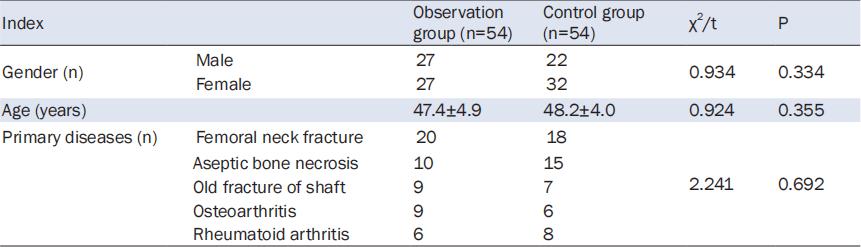
There were no significant differences between the two groups in terms of gender, age, and primary diseases (all P>0.05), indicating that the two groups were comparable (Table 1).

Postoperative complications
In the observation group, the incidence of lower extremity thrombosis was 0%, and the overall complication rate was 3.7%. In the control group, the incidence of lower extremity thrombosis was 7.41% and the overall complication rate was 14.81%.
The observation group had a significantly lower incidence of lower extremity thrombosis and overall complications compared to the control group (P<0.05) (Table 2).
Psychological state
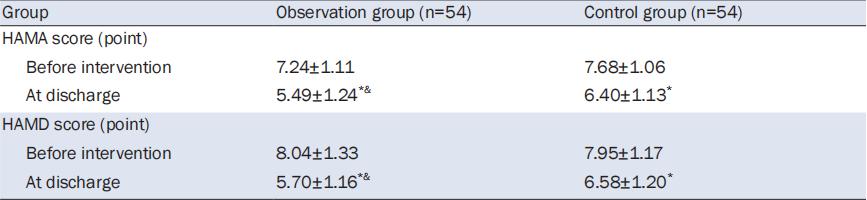
There were no significant differences in the HAMA and HAMD scores between the two groups before intervention (P>0.05). One month after discharge, patients in both groups showed reduced scores, with the observation group exhibiting significantly lower scores than the control group (P<0.05) (Table 3).
Quality of life
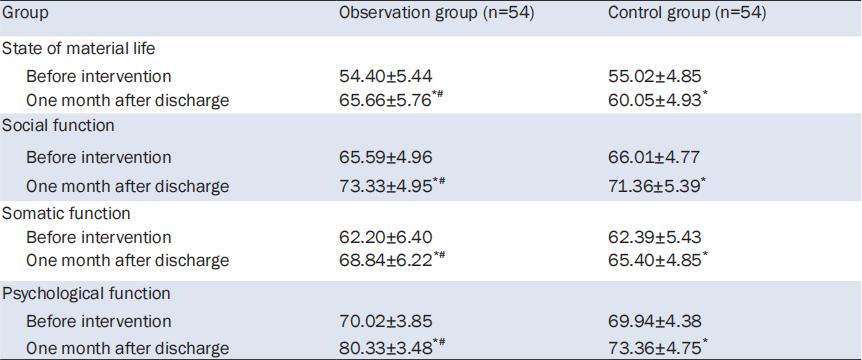
There were no statistical differences in GQOLI-74 scores between the two groups before intervention (P>0.05). After one month of intervention, scores increased in both groups, with a more significant improvement observed in the observation group (P<0.05) (Table 4).
Table 4. Comparison of GQOLI-74 scores between the two groups before and after intervention (x̅ ± s)
Activities of daily living
Patient satisfaction

High-quality, efficient, comprehensive, and meticulous perioperative care plays a crucial role in reducing the risk of complications and accelerating recovery after hip arthroplasty [15, 16]. Evidence-based care is a nursing mode that minimizes the risk of postoperative complications and improves patient prognosis by reviewing extensive literature to identify factors that may influence patient recovery and applying effective nursing measures based on proven results [17, 18].
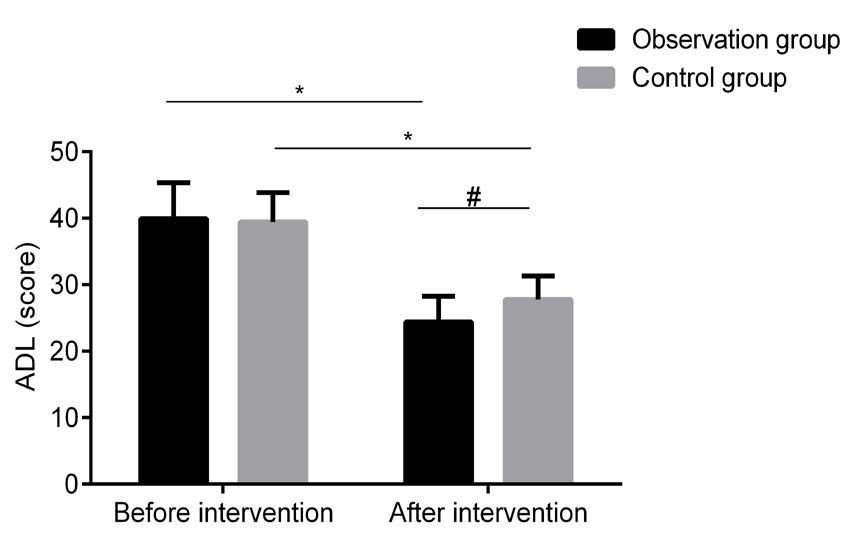
In the present study, the observation group experienced a lower incidence of postoperative lower-limb thrombosis and overall complications. After one month of intervention, the GQOLI-74 scores in the observation group were higher than those in control group, while ADL scores were lower. These findings indicate that evidence-based care effectively reduced the risk of postoperative lower-limb thrombosis, lowers the incidence of postoperative complications, and improves ADL and QoL in patients undergoing hip arthroplasty during perioperative period. Consistent with our results, Monagle et al. reported that compared with conventional care, the perioperative use of evidence-based care greatly reduced the risk of postoperative DVT of lower limbs and enhanced the prognosis of orthopedic surgery patients [19]. A possible reason for these outcomes is that the leading cause of DVT, decreased venous return velocity due to prolonged bed rest and local swelling of the affected limb, was addressed before the implementation of nursing care, making the care more targeted. For example, placing a soft pillow under the affected limb postoperatively helps promote venous return, preventing lower limb DVT, which subsequently reduces postoperative complications, accelerates postoperative recovery, and improves QoL [20].
The lower HAMA and HAMD scores in observation group suggest that evidence-based care effectively alleviates patients' anxiety and other negative emotions during the perioperative period. Benton et al. hypothesized that the significant improvement in postoperative psychological well-being achieved with evidence-based care is due to alleviating patients' concerns about prognosis induced by prolonged bed rest [21]. In addition, the lengthy and challenging rehabilitation process, to walk normally, necessary for normal walking, is a major contributor to patients' irritability and anxiety. By addressing the factors that induce patients' unhealthy psychological status, targeted psychological counseling, including preoperative health education and postoperative care from their families, helps to eliminate patients' worries, nervousness, inferiority and irritability [22]. Furthermore, the satisfaction rate was significantly higher in the observation group, suggesting that patients who received hip arthroplasty were more satisfied with the evidence-based care.
Author Contributions
Haixia Du contributed to study design, data collection, and manuscript drafting. Xiaoyuan Tang participated in data analysis and manuscript revision. Lihong Lu supervised the study, guided the research process, and finalized the manuscript. All authors approved the final version.


 On This Page
 CITE
CITE