 Log In
Search




 Open Access
 gaojiehighclea@smmu.edu.cn.
h_b_cui@163.com.
gaojiehighclea@smmu.edu.cn.
h_b_cui@163.com.Jie Gao, College of Health Science and Engineering, University of Shanghai for Science and Technology, No. 516 Jungong Road, Yangpu District, Shanghai 200093, China. E-mail: gaojiehighclea@smmu.edu.cn. Haipo Cui, College of Health Science and Engineering, University of Shanghai for Science and Technology, No. 516 Jungong Road, Yangpu District, Shanghai 200093, China. E-mail: h_b_cui@163.com.
Immunotherapy bypasses antibiotic resistance, induces long-term immune memory, and forms a “prevention–treatment–relapse–prevention” loop.
This review summarizes major breakthroughs in Helicobacter pylori vaccine development, compares the advantages and limitations of different vaccine types, and highlights promising clinical directions for antibody therapy.
This review focuses on the application of nanodevices in Helicobacter pylori immunotherapy and highlights the key role of nanotechnology in overcoming current therapeutic bottlenecks.
This review proposes establishing a precise, durable immune prevention and treatment system while exploring novel therapeutic directions to address challenges in Helicobacter pylori immunotherapy.
Open Accessgaojiehighclea@smmu.edu.cn.h_b_cui@163.com.Jie Gao, College of Health Science and Engineering, University of Shanghai for Science and Technology, No. 516 Jungong Road, Yangpu District, Shanghai 200093, China. E-mail: gaojiehighclea@smmu.edu.cn. Haipo Cui, College of Health Science and Engineering, University of Shanghai for Science and Technology, No. 516 Jungong Road, Yangpu District, Shanghai 200093, China. E-mail: h_b_cui@163.com.
Immunotherapy bypasses antibiotic resistance, induces long-term immune memory, and forms a “prevention–treatment–relapse–prevention” loop.
This review summarizes major breakthroughs in Helicobacter pylori vaccine development, compares the advantages and limitations of different vaccine types, and highlights promising clinical directions for antibody therapy.
This review focuses on the application of nanodevices in Helicobacter pylori immunotherapy and highlights the key role of nanotechnology in overcoming current therapeutic bottlenecks.
This review proposes establishing a precise, durable immune prevention and treatment system while exploring novel therapeutic directions to address challenges in Helicobacter pylori immunotherapy.
Keywords: Helicobacter pylori, Immunotherapy, Nanodevices, Vaccine, Antibody
Helicobacter pylori (HP), a type I carcinogen carried by approximately 50% of the global population, is a major risk factor for gastric cancer, with about 85% of gastric cancer cases being associated with its infection [1]. After infection, the disease may progress in a cascade from “chronic gastritis” to “atrophy/intestinal metaplasia” to “dysplasia” and finally to “gastric cancer”, and may also be accompanied by ulcers or mucosa-associated lymphoid tissue lymphoma [2].
Currently, the main clinical approach for HP infection is triple or quadruple therapy consisting of a proton pump inhibitor combined with antibiotics. However, the increasingly serious problem of antibiotic resistance is significantly weakening its efficacy [3]. According to statistics, the number of deaths worldwide due to antibiotic-resistant infections exceeded 6 million in 2019 [4]. Among them, the resistance rate of HP to first-line drugs such as metronidazole and clarithromycin has been continuously rising over the past decade, and in some regions the rate even exceeds 50% [5]. More concerning is that even after successful HP eradication, patients still face a high risk of reinfection, with annual reinfection rates of 3.4% in high-income countries and 8.7% in low-income countries [6]. Although novel biomaterial-based therapies show some potential in reducing HP colonization, they cannot establish durable immune protection and are thus unable to prevent reinfection.
In this context, immunotherapy stands out. This therapy does not rely on antibiotics and can effectively circumvent the risk of resistance. It not only has the potential to activate the host’s specific immune response against HP, more thoroughly eliminate existing infection, and induce long-term immune memory, thereby fundamentally reducing the reinfection rate, but can also serve as a supplement to conventional therapies. In clinical practice, comprehensive measures such as screening high-risk populations, implementing simultaneous eradication in families, and strengthening oral hygiene and public health education are often adopted to build an effective prevention and control system. The combination of immunotherapy with these measures is expected to form a complete closed loop of “prevention–treatment–relapse–prevention”, which is a key strategy for achieving long-term control of HP infection and blocking disease progression. A schematic overview of the HP infection cascade and the immunotherapeutic strategies discussed in this review is presented in Figure 1.

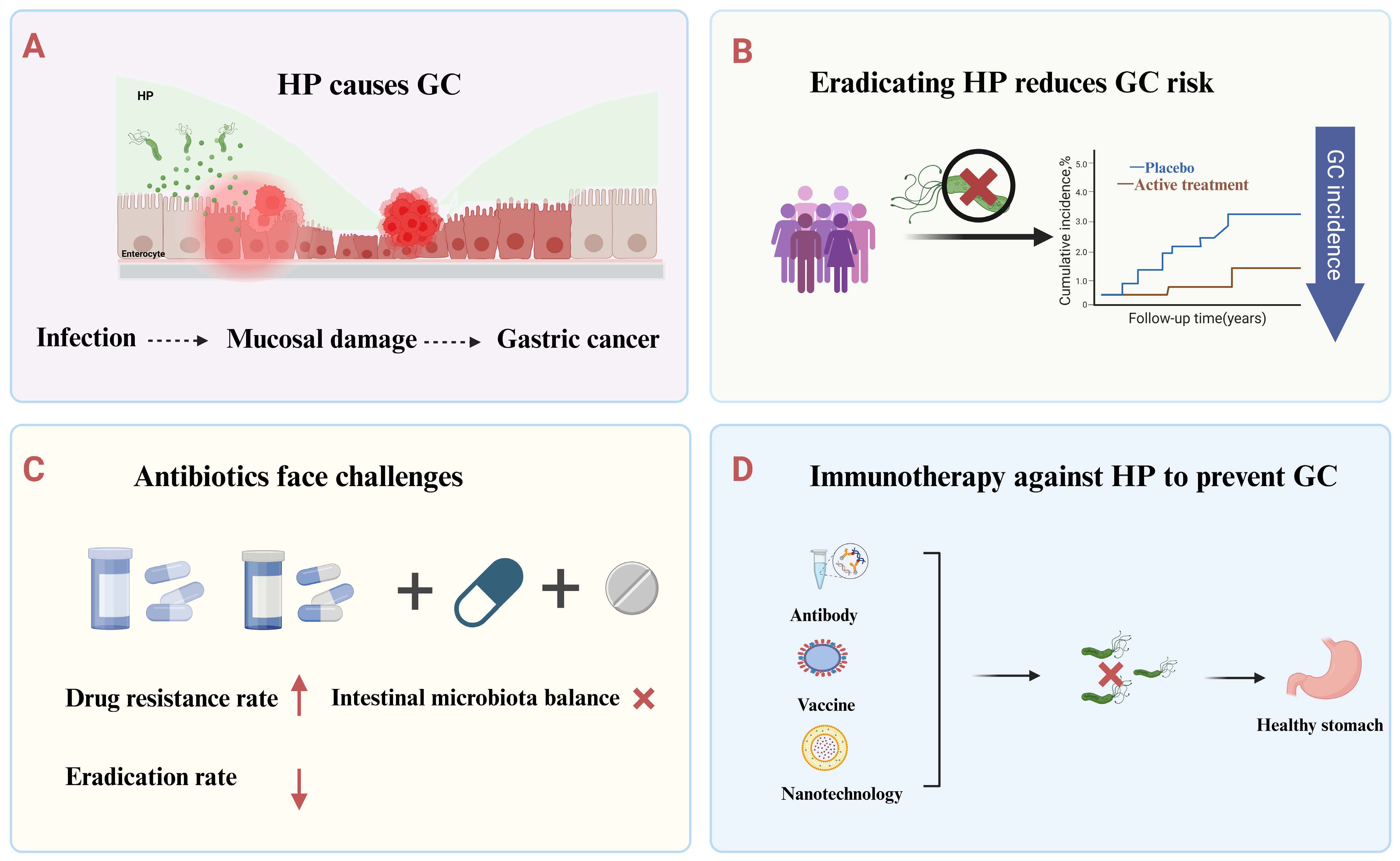
HP can achieve long-term colonization by employing multi-level and multi-mechanism immune evasion strategies, which disrupt host immune homeostasis. At the molecular level, HP can modify its own structure to reduce the immunogenicity of its pathogen-associated molecular patterns and evade host immune recognition [7, 8].
At the cellular regulation level, HP not only inhibits the proliferation and maturation of T lymphocytes but also regulates the balance of T helper 17 (Th17) and regulatory T cells to induce immune tolerance, weakening the host’s pathogen-clearing capacity [9-12]. Additionally, key virulence factors secreted by HP, such as cytotoxin-associated gene A and vacuolating cytotoxin A, can interfere with T cell activation signaling pathways, further suppressing the adaptive immune response.
Notably, HP also impairs immune cell function, reducing their ability to phagocytose and clear HP [13, 14]. For instance, HP infection can disrupt the localization of nicotinamide adenine dinucleotide phosphate oxidase in neutrophils and prevent the accumulation of reactive oxygen species within phagosomes, thereby helping the bacterium evade killing [15]. Meanwhile, HP modulates macrophage function through multiple dimensions, inhibits antigen presentation, blocks pro-inflammatory polarization, and ultimately establishes an immunosuppressive microenvironment to evade host clearance. These highly coordinated immune evasion mechanisms collectively constitute the survival strategy of HP, enabling long-term colonization in the gastric mucosa and eventually leading to pathological changes such as chronic gastritis.
The HP vaccine stimulates a specific immune response, which can not only eliminate existing infections but also establish long-lasting immune memory. It has the advantages of high cost-effectiveness and the potential to reduce incidence through herd immunity, making it a fundamental strategy for preventing HP infections. However, its development faces three major challenges: the complex immune evasion mechanism of HP, significant genetic diversity, and differences in host immune responses. The key to overcoming these bottlenecks lies in achieving the synergistic optimization of adjuvants and antigens.
On the one hand, adjuvants can enhance the immune response of vaccine antigens by prolonging antigen retention time and improving antigen presentation. Traditional mucosal adjuvants such as cholera toxin (CT) and heat-labile enterotoxin of Escherichia coli can effectively enhance the immune response, but their strong enterotoxicity limits their clinical application [16, 17]. CpG oligodeoxynucleotide and polyinosinic-polycytidylic acid, as novel Toll-like receptor agonist adjuvants, have shown great potential in HP vaccine development. Polyinosinic-polycytidylic acid has unique advantages in inducing mucosal immunity, while CpG oligodeoxynucleotide excels in driving T helper 1 (Th1)-type systemic immunity. The combination of the two exerts a synergistic effect, achieving dual enhancement of mucosal and systemic immunity, providing a new strategy for the development of effective HP vaccines [18, 19]. On the other hand, given the high genetic diversity of HP, the ideal vaccine antigen should possess conservation, essentiality, and strong immunogenicity. Current research has explored various vaccine strategies, and by incorporating novel adjuvant systems, it is expected to overcome the immune evasion barrier of HP and develop effective and safe vaccines.
3.1 Whole-cell vaccine
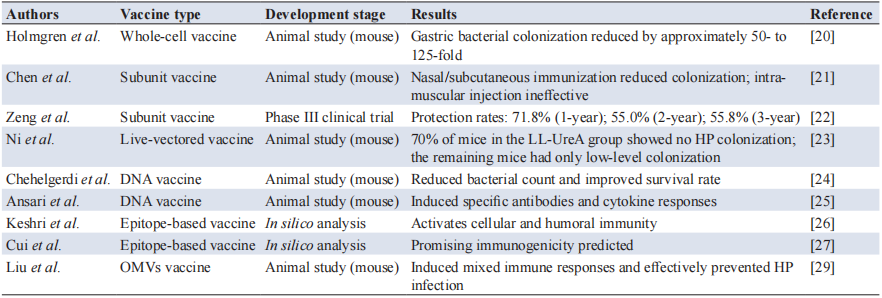
The whole-cell vaccine contains all the antigens of HP, thus having a complex antigenic composition and being capable of inducing an effective immune response. One common strategy for preparing whole-cell vaccines is to use inactivated HP as the vaccine. This method avoids the safety risks associated with using live bacterial strains, but it also retains the various antigenic components of the pathogen. The formaldehyde-inactivated HP whole-cell vaccine developed by Holmgren et al., combined with a multiple mutant CT adjuvant, can significantly reduce HP colonization in the stomach of mouse models and trigger strong serum immunoglobulin G (IgG), mucosal immunoglobulin A (IgA) antibody responses, as well as T-cell-mediated interferon-gamma (IFN-γ) and interleukin-17A cytokine responses [20].
3.2 Subunit vaccine
Subunit vaccines use key proteins or sugars of the pathogen as antigens, rather than the entire pathogen, which can avoid potential toxicity or adverse reactions. However, the immunogenicity of such antigens is often weak, so the synergistic effect of adjuvants becomes the key to enhancing the efficacy. For example, Chen et al. found that the HP subunit vaccine using cyclic guanosine monophosphate-adenosine monophosphate as an adjuvant could significantly enhance the IgG and IgA antibody response when administered through different immunization routes to mice, and improve the overall immune defense ability [21].
In terms of antigen selection, urease subunit B (UreB), due to its core role in HP colonization and pathogenesis, as well as its unique advantages of being non-toxic, highly conserved, and highly immunogenic, has become a popular target for subunit vaccine development. Zeng et al. took this as a breakthrough point and developed an oral recombinant HP vaccine with UreB as the main antigen and the heat-labile enterotoxin B subunit as the mucosal adjuvant, and completed a phase 3 clinical trial in Chinese children [22]. This is the world’s first HP vaccine to complete this process.
With the development of genetic engineering technology, subunit vaccines can use genetic engineering methods to produce the key proteins of HP, featuring high controllability, high safety, and ease of large-scale production.
3.3 Live-vectored vaccine
Live vector vaccines often employ attenuated or non-pathogenic microorganisms as vectors to carry antigen genes of the target pathogen, infecting host cells and expressing the antigens to elicit an immune response. For HP, researchers have developed various vector systems based on lactic acid bacteria and attenuated Salmonella. For example, Ni et al. constructed a recombinant live bacterial vaccine using food-grade Lactococcus lactis as a vector to express urease subunit A (UreA) and a fusion protein consisting of UreA fused to the heat-labile enterotoxin B subunit of Escherichia coli. Studies have confirmed that oral immunization with this vaccine effectively induces mucosal secretory IgA responses and Th1/Th17-type cellular immune responses in mice, while significantly reducing gastric HP colonization, with the recombinant Lactococcus lactis expressing UreA group achieving a protection rate of 70% [23].
3.4 DNA vaccine
DNA vaccines typically contain DNA sequences encoding HP antigens and are administered orally or mucosally, allowing host cells to take up and express the antigens, thereby eliciting an immune response. Chehelgerdi et al. designed a DNA vaccine based on the cagW gene. The vaccine was constructed by cloning the cagW gene of HP into the pcDNA3.1(+) vector and encapsulating it with chitosan nanoparticles to enhance immunogenicity and protective efficacy [24]. Ansari et al. developed a DNA vaccine based on the flaA gene, which induced a significant immune response in mice following intramuscular immunization [25].
Compared with traditional vaccines, DNA vaccines offer advantages such as ease of design and modification, as well as sustained expression. Currently, although DNA vaccines have shown promising results in laboratory studies, challenges remain in clinical application, including the intensity and persistence of the immune response. Nevertheless, some candidate vaccines have achieved positive outcomes in clinical trials, offering hope for translational application.
3.5 Epitope-based vaccine
In recent years, with a deeper understanding of antigen structure and immune response mechanisms, the design of novel epitope vaccines has attracted increasing attention. This type of vaccine targets specific antigenic determinants on the pathogen surface, enabling precise induction of specific immune responses, thereby overcoming the design limitations of traditional vaccines. Keshri et al. designed a multi-epitope vaccine that integrates T cell, B cell, and IFN-γ-inducing epitopes, capable of simultaneously activating cellular and humoral immunity [26]. Cui et al. employed immunoinformatics tools to design a novel multi-epitope HP vaccine containing epitopes from nine essential proteins, and predicted and evaluated its physicochemical properties using software tools and online servers [27].
By precisely targeting key regions of the pathogen, epitope vaccines can circumvent the non-specific reactions and allergy risks associated with traditional vaccines. Their innovative strategies, such as multi-epitope synergy and computer-aided design, open up efficient and personalized approaches for the prevention and treatment of HP infection.
3.6 Outer membrane vesicles (OMVs) vaccine
OMVs vaccines are a novel vaccine platform constructed based on the naturally secreted nanovesicles of bacteria. They naturally carry the membrane components and virulence factors of HP, mimic infection, and efficiently activate innate immunity through their intrinsic adjuvant activity [28]. For example, Liu et al. successfully reversed immune evasion by knocking out lipopolysaccharide (LPS) modification genes in HP and displayed antigens on the OMVs surface using the autotransporter system. Oral immunization with this recombinant OMVs vaccine in mice successfully induced mixed Th1/Th2/Th17 cellular immune responses and high levels of specific antibodies, significantly reducing gastric HP colonization and demonstrating excellent protective efficacy [29].
However, the development of OMVs vaccines still faces challenges. Their naturally carried LPS may cause adverse reactions due to excessive immune activation, and the inclusion of virulence factors such as cytotoxin-associated gene A within the vesicles poses safety risks. In the future, it will be necessary to finely regulate the components of OMVs through genetic engineering to balance efficacy and safety while maintaining strong immunogenicity. In summary, OMVs, with their biomimetic structure, efficient delivery, and self-adjuvanting ability, offer a promising and innovative strategy for the development of HP vaccines.
3.7 Comparative summary of vaccine types
Whole-cell vaccines induce broad humoral and mucosal immunity but are limited by complex antigen composition and reliance on enterotoxic adjuvants such as CT/heat-labile enterotoxin. Although non-toxic adjuvants like multiple mutant CT have shown potential in animal models, research on whole-cell vaccines has generally declined. Subunit vaccines, particularly the oral recombinant UreB-based vaccine, have completed phase III trials. They offer well-defined components and high safety for prophylactic immunization in high-risk populations; however, their weak immunogenicity necessitates adjuvant support. Live vector vaccines mimic natural infection and induce robust mucosal immunity, but safety concerns and poor in vivo efficacy limit them to preclinical or phase I stages. DNA vaccines are flexible and cost-effective yet suffer from low immunogenicity and poor delivery efficiency, often requiring nanocarriers for enhancement. Most remain at the preclinical stage. Epitope vaccines offer high safety and are amenable to computer-aided design; however, single-epitope constructs exhibit weak immunogenicity and limited major histocompatibility complex polymorphism coverage, confining them to in silico or early animal studies [30, 31]. OMVs have emerged as a research hotspot. Their natural nanoparticle structure provides self-adjuvant activity and effectively induces Th1/Th2/Th17 and mucosal immunity. Nonetheless, genetic engineering is needed to reduce LPS toxicity and virulence factor risks, and they remain at the preclinical stage [30, 32]. A comparative summary of the six vaccine types is presented in Table 1.
Compared with vaccine therapy, which establishes long-term protection through active immunity, antibody therapy acts directly by passively administering specific antibodies, providing an immediate solution for acute infections and the management of drug-resistant strains. This therapy employs diverse mechanisms of action, including preventing HP adhesion to gastric mucosal epithelial cells, neutralizing virulence factors, and inhibiting colonization and growth. For example, Hong et al. developed a monoclonal antibody targeting vacuolating cytotoxin A that neutralizes its toxicity and alleviates damage to gastric mucosal cells [33]. Deng et al. developed immunoglobulin Y (IgY) antibodies against multiple colonization-related proteins, including flagellin A, blood group antigen-binding adhesin A2, neutrophil-activating protein A, HP adhesion protein A, and UreB, among which anti-FlaA IgY exhibited the strongest inhibitory effect on HP growth and adhesion. The study also found that combined use of antibodies targeting different functional proteins could form a multi-dimensional anti-infection strategy by simultaneously blocking bacterial motility, adhesion, and gastric acid neutralization [34].
Clinical studies have shown that oral administration of multivalent anti-HP IgY alone significantly improves clinical symptoms and increases the eradication rate in patients with HP infection [35]. Moreover, in patients with previous eradication failure, its combination with bismuth-based quadruple therapy did not significantly increase the eradication rate but more effectively alleviated symptoms and reduced adverse reactions, thereby further enhancing the clinical efficacy of salvage treatment [36]. These findings provide a basis for the practical application of antibody therapy.
Currently, key challenges that remain to be addressed include the oral stability of antibodies, extension of half-life, and cost control. With technological optimization, antibodies are expected to play an important role in the treatment of HP.
Traditional immunotherapy faces multiple bottlenecks, including gastric acid degradation, the mucosal barrier, and immune tolerance. However, various nanodevices, owing to their unique structural designs and physicochemical properties, offer systematic solutions to overcome these obstacles.
5.1 Nano-delivery systems
Nano-delivery systems enable precise regulation of the distribution and release of active vaccine components in vivo, thereby providing a versatile technological platform for HP immunotherapy. To address the challenges posed by gastric acid degradation and the mucosal barrier in oral vaccination, Chan et al. developed a chitosan/DNA oral vaccine (chitosan/plasmid-UreB nanoparticles) that remains stable in simulated gastric fluid and effectively transfects gastric epithelial cells. Following oral immunization, mice developed robust mucosal IgA and systemic IgG responses, with elevated levels of IFN-γ and interleukin-17, and a 150-fold reduction in gastric HP colonization [37]. To overcome the poor induction of intestinal mucosal immunity by subcutaneous vaccines, Xie et al. developed a lactoferrin-stabilized squalene nanoemulsion that mimics neutrophil granule function. This emulsion co-delivers dual antigens (UreB and HP adhesion protein A), retinoic acid, and the CpG adjuvant. Upon subcutaneous injection, it forms a local drug depot, recruits neutrophils and dendritic cells, and, via retinoic acid, induces high expression of the gut-homing receptor C-C chemokine receptor type 9 on immune cells, guiding the targeted migration of activated lymphocytes to the gastrointestinal tract and ultimately achieving a protective efficacy of 91.3% [38]. Furthermore, He et al. developed a buccal microneedle patch (MN-Gel@MU, where MN denotes microneedle and MU represents the mesoporous silica-hydrogel composite) that encapsulates UreB using mesoporous silica and hydrogel, exhibiting excellent mechanical strength and resistance to salivary washout. Its S-shaped release profile (slow followed by rapid) avoids mucosal tolerance, promotes the recruitment and maturation of antigen-presenting cells, and ultimately induces potent secretory IgA and systemic immune responses in distal mucosal sites such as the stomach and intestine [39].
These nano-delivery systems, based on three cutting-edge strategies-oral genetic immunization, subcutaneous induction of gut homing, and local buccal microneedle delivery-activate mucosal immunity by precisely modulating antigen exposure kinetics, thereby providing innovative nanotechnological platforms and design paradigms for HP immunotherapy.
5.2 Responsive nanodevices
Responsive nanodevices enable locally controllable therapy. Li et al. designed a thermosensitive liposome system (BT@CPA) co-loaded with clarithromycin and anti-programmed death-ligand 1 (PD-L1) peptide-modified gold nanorods. Upon irradiation with a 1,064 nm laser, the gold nanorods generate mild hyperthermia (~45 °C), triggering liposome disintegration and antibiotic release while increasing bacterial membrane permeability. Concurrently, the released anti-PD-L1 peptide blocks the PD-L1/programmed death-1 axis, reverses T-cell apoptosis, and restores anti-infective immunity. This platform achieves triple synergy of photothermal therapy, chemotherapy, and immune checkpoint blockade, resulting in an in vivo clearance rate exceeding 99% and marked alleviation of gastritis [40]. Furthermore, antibody-targeted enhanced physical bactericidal devices have demonstrated significant value. Zhi et al. functionalized gold nanostars with anti-HP antibodies (GNS@Ab), which, after oral administration, specifically bind to bacteria and generate a photothermal effect (~45 °C) under 790 nm laser irradiation, efficiently eliminating drug-resistant bacteria [41]. Wang et al. constructed antibody-conjugated liposomes encapsulating indocyanine green (HpAb-LiP-ICG); upon ultrasound excitation, they produce reactive oxygen species via sonodynamic action, disrupting bacterial membranes with an in vitro bactericidal rate of 99.9% [42]. In summary, responsive nanodevices provide a spatiotemporally controllable and synergistically enhanced universal platform for HP immunotherapy.
This review discusses three main immunotherapeutic strategies against HP: vaccines, antibody-based therapies, and nanodevice-based immunotherapy. In vaccine development, various platforms have been explored. Among them, subunit vaccines lead in clinical translation, while OMVs represent a next-generation candidate due to their self-adjuvanting and natural delivery properties. Antibody-based therapies have shown certain clinical promise. Notably, the application of nanodevices in immunotherapy provides a feasible approach to overcoming current bottlenecks and enabling clinical translation, particularly through nano-delivery systems and responsive nanodevices, which allow for spatiotemporally controlled drug release, improved antigen presentation, and synergistic therapeutic effects.
Despite promising preclinical results, clinical translation of HP immunotherapy faces several challenges: interindividual variability in immune responses, limited durability of vaccine-induced immune memory, and poor oral delivery efficiency due to the gastric acidic environment and mucosal barrier. Future research should focus on establishing a more precise and durable immune prevention system. This includes patient stratification based on host and pathogen characteristics, and sequential strategies combining vaccines, antibodies, and nanodelivery — for example, early neutralizing antibodies followed by mucosal vaccination with pH-responsive nanosystems. Novel directions such as microbiota modulation using an artificial intelligence-designed I107W antibody and engineered Escherichia coli Nissle 1917 probiotics and epigenetic intervention by reversing C-X-C motif chemokine ligand 1 hypomethylation with demethylating agents are also promising [43, 44]. Additionally, health economics and accessibility must be considered. With interdisciplinary collaboration and innovative trial design, HP immunotherapy holds potential for clinical translation.
Author contributions
Haowei Wu made substantial contributions to the conception and design of the study and performed data analysis and interpretation. Jing Wang, Tinglin Zhang, Jie Gao, and Haipo Cui contributed to data acquisition, and provided administrative, technical, and material support.
Funding
This work was supported by National Key Laboratory of Basic Medical Innovation Open Project (JCKFKT-MS-006), The First Batch of Open Projects of Shanghai Key Laboratory of Maritime Medicine and Pharmaceutical Conversion (2025QN13), Shanghai 2025 Basic Research Plan Natural Science Foundation (25ZR1401393).
Data availability
Not applicable. No datasets were generated or analyzed during the current study.
Ethics approval and consent to participate
Not applicable.
Consent for publication
Not applicable.
Competing interests
All authors declared that there are no conflicts of interest.
Acknowledgements
The authors thank the members of the Clinical Research Center of Shanghai Changhai Hospital for their valuable discussions. The authors also acknowledge the University of Shanghai for Science and Technology for its support. Figures were created with BioRender software.
[1] Kuo Y, Yu L, Wang H, Chen M, Wu M, Liu C, et al. Effects of Helicobacter pylori infection in gastrointestinal tract malignant diseases: From the oral cavity to rectum. World J Gastrointest Oncol. 2022 Jan 15;14(1):55-74. https://doi.org/10.4251/wjgo.v14.i1.55
[2] Malfertheiner P, Camargo MC, El-Omar E, Liou JM, Peek R, Schulz C, et al. Helicobacter pylori infection. Nat Rev Dis Primers. 2023 Apr 20;9(1):19. https://doi.org/10.1038/s41572-023-00431-8
[3] Kuo YT, Liou JM, El-Omar EM, Wu JY, Leow AHR, Goh KL, et al. Primary antibiotic resistance in Helicobacter pylori in the Asia-Pacific region: A systematic review and meta-analysis. Lancet Gastroenterol Hepatol. 2017 Oct;2(10):707-715. https://doi.org/10.1016/s2468-1253(17)30219-4
[4] Murray CJL, Ikuta KS, Sharara F, Swetschinski L, Robles Aguilar G, Gray A, et al. Global burden of bacterial antimicrobial resistance in 2019: A systematic analysis. Lancet. 2022 Feb 12;399(10325):629-655. https://doi.org/10.1016/s0140-6736(21)02724-0
[5] Yu Y, Xue J, Lin F, Liu D, Zhang W, Ru S, et al. Global primary antibiotic resistance rate of Helicobacter pylori in recent 10 years: A systematic review and meta-analysis. Helicobacter. 2024 May-Jun;29(3):e13103. https://doi.org/10.1111/hel.13103
[6] Hu Y, Zhu Y, Lu N. Novel and effective therapeutic regimens for Helicobacter pylori in an era of increasing antibiotic resistance. Front Cell Infect Microbiol. 2017 May 5;7:168. https://doi.org/10.3389/fcimb.2017.00168
[7] Li H, Yang T, Liao T, Debowski AW, Nilsson HO, Haslam SM, et al. Insights from the redefinition of Helicobacter pylori lipopolysaccharide O-antigen and core-oligosaccharide domains. Microb Cell. 2017 Apr 25;4(5):175-178. https://doi.org/10.15698/mic2017.05.574
[8] Varga MG, Peek RM. DNA transfer and Toll-like receptor modulation by Helicobacter pylori. Curr Top Microbiol Immunol. 2017;400:169-193. https://doi.org/10.1007/978-3-319-50520-6_8
[9] Lina TT, Alzahrani S, House J, Yamaoka Y, Sharpe AH, Rampy BA, et al. Helicobacter pylori cag pathogenicity island's role in B7-H1 induction and immune evasion. PLoS One. 2015 Mar 25;10(3):e0121841. https://doi.org/10.1371/journal.pone.0121841
[10] Zabaleta J, McGee DJ, Zea AH, Hernández CP, Rodriguez PC, Sierra RA, et al. Helicobacter pylori arginase inhibits T cell proliferation and reduces the expression of the TCR zeta-chain (CD3zeta). J Immunol. 2004 Jul 1;173(1):586-593. https://doi.org/10.4049/jimmunol.173.1.586
[11] Kao J, Zhang M, Miller MJ, Mills JC, Wang B, Liu M, et al. Helicobacter pylori immune escape is mediated by dendritic cell-induced Treg skewing and Th17 suppression in mice. Gastroenterology. 2010 Mar;138(3):1046-1054. https://doi.org/10.1053/j.gastro.2009.11.043
[12] Oertli M, Sundquist M, Hitzler I, Engler DB, Arnold IC, Reuter S, et al. DC-derived IL-18 drives Treg differentiation, murine Helicobacter pylori-specific immune tolerance, and asthma protection. J Clin Invest. 2012 Mar;122(3):1082-1096. https://doi.org/10.1172/jci61029
[13] Kunz TC, Viana F, Buchrieser C, Escoll P. Manipulation of autophagy by bacterial pathogens impacts host immunity. Curr Issues Mol Biol. 2018;25:81-98. https://doi.org/10.21775/cimb.025.081
[14] Xie C, Li N, Wang H, He C, Hu Y, Peng C, et al. Inhibition of autophagy aggravates DNA damage response and gastric tumorigenesis via Rad51 ubiquitination in response to H. pylori infection. Gut Microbes. 2020 Nov 1;11(6):1567-1589. https://doi.org/10.1080/19490976.2020.1774311
[15] Allen LA, Beecher BR, Lynch JT, Rohner OV, Wittine LM. Helicobacter pylori disrupts NADPH oxidase targeting in human neutrophils to induce extracellular superoxide release. J Immunol. 2005 Mar 15;174(6):3658-3667. https://doi.org/10.4049/jimmunol.174.6.3658
[16] Holmgren J, Lycke N, Czerkinsky C. Cholera toxin and cholera B subunit as oral-mucosal adjuvant and antigen vector systems. Vaccine. 1993 Sep;11(12):1179-1184. https://doi.org/10.1016/0264-410x(93)90039-z
[17] Zhao T, Cai Y, Jiang Y, He X, Wei Y, Yu Y, et al. Vaccine adjuvants: Mechanisms and platforms. Signal Transduct Target Ther. 2023 Jul 19;8(1):283. https://doi.org/10.1038/s41392-023-01557-7
[18] Sun M, Liu Y, Ni X, Tan R, Wang Y, Jiang Y, et al. Intranasal immunization with poly I:C and CpG ODN adjuvants enhances the protective efficacy against Helicobacter pylori infection in mice. Microbes Infect. 2025 Mar-Apr;27(3):105433. https://doi.org/10.1016/j.micinf.2024.105433
[19] Vedelago G, Palacios LM, Castell SD, Marin C, Ruiz Moreno FN, Felici ME, et al. Differential innate immune activation by four different CpG-ODNs in porcine and murine cells: Implications for vaccine design. Res Vet Sci. 2025 Aug;191:105692. https://doi.org/10.1016/j.rvsc.2025.105692
[20] Holmgren J, Nordqvist S, Blomquist M, Jeverstam F, Lebens M, Raghavan S. Preclinical immunogenicity and protective efficacy of an oral Helicobacter pylori inactivated whole cell vaccine and multiple mutant cholera toxin: A novel and non-toxic mucosal adjuvant. Vaccine. 2018 Oct 1;36(41):6223-6230. https://doi.org/10.1016/j.vaccine.2018.07.073
[21] Chen J, Zhong Y, Liu Y, Tang C, Zhang Y, Wei B, et al. Parenteral immunization with a cyclic guanosine monophosphate-adenosine monophosphate (cGAMP) adjuvanted Helicobacter pylori vaccine induces protective immunity against H. pylori infection in mice. Hum Vaccin Immunother. 2020 Nov 1;16(11):2849-2854. https://doi.org/10.1080/21645515.2020.1744364
[22] Zeng M, Mao X, Li J, Tong W, Wang B, Zhang Y, et al. Efficacy, safety, and immunogenicity of an oral recombinant Helicobacter pylori vaccine in children in China: a randomised, double-blind, placebo-controlled, phase 3 trial. Lancet. 2015 Oct 10;386(10002):1457-1464. https://doi.org/10.1016/s0140-6736(15)60310-5
[23] Ni X, Liu Y, Sun M, Jiang Y, Wang Y, Ke D, et al. Oral live-carrier vaccine of recombinant Lactococcus lactis inducing prophylactic protective immunity against Helicobacter pylori infection. Probiotics Antimicrob Proteins. 2025 Dec;17(6):4111-4123. https://doi.org/10.1007/s12602-024-10360-x
[24] Chehelgerdi M, Doosti A. Effect of the cagW-based gene vaccine on the immunologic properties of BALB/c mouse: An efficient candidate for Helicobacter pylori DNA vaccine. J Nanobiotechnology. 2020 Apr 21;18(1):63. https://doi.org/10.1186/s12951-020-00618-1
[25] Ansari H, Tahmasebi-Birgani M, Bijanzadeh M. DNA vaccine containing Flagellin A gene induces significant immune responses against Helicobacter pylori infection: An in vivo study. Iran J Basic Med Sci. 2021 Jun;24(6):796-804. https://doi.org/10.22038/ijbms.2021.54415.12227
[26] Keshri AK, Kaur R, Rawat SS, Arora N, Pandey RK, Kumbhar BV, et al. Designing and development of multi-epitope chimeric vaccine against Helicobacter pylori by exploring its entire immunogenic epitopes: An immunoinformatic approach. BMC Bioinformatics. 2023 Sep 22;24(1):358. https://doi.org/10.1186/s12859-023-05454-2
[27] Cui M, Ji X, Guan F, Su G, Du L. Design of a Helicobacter pylori multi-epitope vaccine based on immunoinformatics. Front Immunol. 2024 Aug 23;15:1432968. https://doi.org/10.3389/fimmu.2024.1432968
[28] Li J, Liao T, Chua EG, Zhang M, Shen Y, Song X, et al. Helicobacter pylori outer membrane vesicles: Biogenesis, composition, and biological functions. Int J Biol Sci. 2024;20(10):4029-4043. https://doi.org/10.7150/ijbs.94156
[29] Liu Q, Li B, Ma J, Lei X, Ma J, Da Y, et al. Development of a recombinant outer membrane vesicles (OMVs)-based vaccine against Helicobacter pylori infection in mice. J Extracell Vesicles. 2025 May;14(5):e70085. https://doi.org/10.1002/jev2.70085
[30] Yunle K, Tong W, Jiyang L, Guojun W. Advances in Helicobacter pylori vaccine research: From candidate antigens to adjuvants-a review. Helicobacter. 2024 Jan-Feb;29(1):e13034. https://doi.org/10.1111/hel.13034
[31] Zhang Y, Li X, Shan B, Zhang H, Zhao L. Perspectives from recent advances of Helicobacter pylori vaccines research. Helicobacter. 2022 Dec;27(6):e12926. https://doi.org/10.1111/hel.12926
[32] Zhang H, Liu Z, Li Y, Tao Z, Shen L, Shang Y, et al. Adjuvants for Helicobacter pylori vaccines: Outer membrane vesicles provide an alternative strategy. Virulence. 2024 Dec;15(1):2425773. https://doi.org/10.1080/21505594.2024.2425773
[33] Hong KS, Ki MR, Ullah HMA, Lee EJ, Kim YD, Chung MJ, et al. Preventive effect of anti-VacA egg yolk immunoglobulin (IgY) on Helicobacter pylori-infected mice. Vaccine. 2018 Jan 8;36(3):371-380. https://doi.org/10.1016/j.vaccine.2017.11.082
[34] Deng S, Luo X, Du Y, Elbaioomy RG, He W, Guo R, et al. Immunoglobulin Y antibodies against colonization-related genes block the growth and infection of Helicobacter pylori. Front Immunol. 2025 Jun 18;16:1582250. https://doi.org/10.3389/fimmu.2025.1582250
[35] Guo R, Wu S, Guan L, Xie Y, Yang X, Li Z, et al. Dietary multivalent anti-Helicobacter pylori immunoglobulin Y significantly increase the H. pylori eradication and improve the clinical symptoms in patients. Helicobacter. 2021 Oct;26(5):e12843. https://doi.org/10.1111/hel.12843
[36] Cheng S, Li H, Luo J, Chi J, Zhao W, Lin J, et al. Egg yolk antibody combined with bismuth-based quadruple therapy in Helicobacter pylori infection rescue treatment: A single-center, randomized, controlled study. Front Microbiol. 2023 May 16;14:1150129. https://doi.org/10.3389/fmicb.2023.1150129
[37] Chan Y, Chao Y, Li T, Liao K. Chitosan-based oral DNA vaccine elicits mucosal immunity and reduces Helicobacter pylori colonization in mice. Vaccine. 2025 Oct 3;64:127692. https://doi.org/10.1016/j.vaccine.2025.127692
[38] Xie Z, Zhang Y, Chen X, Zhong X, Wang H, Xie M, et al. Neutrophil granule-mimetic emulsion inducing gastrointestinal immunity against Helicobacter pylori via subcutaneous vaccination. ACS Nano. 2025 Nov 18;19(45):39043-39061. https://doi.org/10.1021/acsnano.5c09796
[39] He P, He C, Guo R, Ou Y, Chang Y, Xie Z, et al. Tough and waterproof microneedles overcome mucosal immunotolerance by modulating antigen release patterns. J Control Release. 2025 Jun 10;382:113740. https://doi.org/10.1016/j.jconrel.2025.113740
[40] Li J, Song X, Huang S, Hu Y, Wang H, Wang R, et al. A Photo-Driven immune modulator combined with chemo-photothermal therapy blocks immune checkpoint for Helicobacter pylori infection. Adv Healthc Mater. 2025 Jul;14(18):e2501197. https://doi.org/10.1002/adhm.202501197
[41] Zhi X, Liu Y, Lin L, Yang M, Zhang L, Zhang L, et al. Oral pH sensitive GNS@ab nanoprobes for targeted therapy of Helicobacter pylori without disturbance gut microbiome. Nanomedicine. 2019 Aug;20:102019. https://doi.org/10.1016/j.nano.2019.102019
[42] Wang R, Song C, Gao A, Liu Q, Guan W, Mei J, et al. Antibody-conjugated liposomes loaded with indocyanine green for oral targeted photoacoustic imaging-guided sonodynamic therapy of Helicobacter pylori infection. Acta Biomater. 2022 Apr 15;143:418-427. https://doi.org/10.1016/j.actbio.2022.02.031
[43] Zhong F, Liu X, Wang X, Hou M, Guo L, Luo X. An AI-designed antibody-engineered probiotic therapy targeting urease to combat Helicobacter pylori infection in mice. Microorganisms. 2025 Sep 1;13(9):2043. https://doi.org/10.3390/microorganisms13092043
[44] Muhammad JS, Manzoor S, Cui ZG, Khoder G. DNA methylation-mediated overexpression of CXCL1 in Helicobacter pylori-induced gastric cancer: In silico- and in vitro-based identification of a potential biomarker for carcinogenesis. Int J Mol Sci. 2023 Jan 2;24(1):795. https://doi.org/10.3390/ijms24010795


 Log In

 On This Page
 CITE
CITE