Search


 Open Access
 yanrongguo@usst.edu.cn
 Objective: Accurately capturing signals from healthcare devices worn on the body is vital for health monitoring, a field of growing interest. A flexible polyvinylidene fluoride (PVDF)-based piezoelectric sensor has been chosen for wearable applications. This study aims to optimize PVDF sensor performance by focusing on structural design. Methods: According to piezoelectric theory, this paper presents a mathematical expression system centered on the first-order piezoelectric equation, which describes the relationship between the electric displacement, the quantity of charge, and the output voltage of the PVDF film under strain. The study focuses on the features of weak physiological signals in the human body to establish a multi-layer shell structure finite element model using COMSOL Multiphysics. The analysis covers the electric displacement field mode, output charge, electric potential, and uniformity of stress distribution. We systematically investigated the impact of PVDF piezoelectric layer area, shape, thickness, and encapsulation materials on sensor performance using the controlled variable method. Results: As the area increases, the sensitivity and stress uniformity improve. Rectangular shapes exhibit more uniform stress distribution than circular shapes, and raising the aspect ratio within a certain range further enhances stress uniformity while maintaining comparable sensitivity. Increasing the thickness of the piezoelectric layer raises the electrical potential. Flexible encapsulation materials can provide higher sensitivity than rigid materials but are more susceptible to stress concentration. Conclusion: This paper finds the best structural form and parameter adjustment range of the PVDF sensor, which can provide a theoretical basis and numerical references for designing high-performance wearable sensors.
Open Access
hechen@usst.edu.cn Objective: To explore the correlation among paraspinal muscle functions electromyography (EMG), muscle stiffness, and pain threshold in patients with adolescent idiopathic scoliosis (AIS). Methods: Eighteen patients with AIS were recruited. A Noraxon system equipped with four wireless EMG sensors was used to collect EMG data on the paraspinal muscles in relaxed standing and weight-bearing standing states. Muscle stiffness and pain threshold were measured using a muscle tonometer. The differences in mean EMG amplitude, muscle stiffness, and pain threshold between the concave and convex sides of the scoliosis were analyzed. Results: Among patients with different scoliosis locations, Cobb angles, ages, and brace treatment durations, the mean EMG amplitude of the paraspinal muscles on the convex side of scoliosis was significantly higher than that on the concave side (P<0.05). The muscle stiffness and pain threshold of the paraspinal muscles on the convex side were also significantly higher than those on the concave side (both P<0.05). There was a low correlation between the mean EMG amplitude of the paraspinal muscles, muscle stiffness, and pain threshold (R<0.5, P>0.05). Conclusion: In AIS patients, the electromyographic activity, muscle stiffness, and pain threshold of the paraspinal muscles on the convex side of scoliosis were all higher than those on the concave side, and the correlation among the three indicators was low.
Open Access
linmao@usst.edu.cn Advanced endoscopic therapeutic techniques, such as endoscopic mucosal resection, endoscopic submucosal dissection, and third-space endoscopy, have transformed digestive endoscopy into a minimally invasive surgical platform. This transformation, nonetheless, poses a major challenge, namely the safe and efficient closure of the postoperative gastrointestinal (GI) defects that arise, as inadequately closed defects may lead to serious postoperative complications. This review provides a comprehensive overview of the historical background, the basic principles of closure, and the technical changes of the mainstream devices used for closure of GI defects, viewed mostly from the perspective of medical devices and engineering design. We have divided the most significant closure devices currently in use into endoscopic clipping devices and endoscopic suturing devices, and we have outlined their respective historical development and working principles. In addition, this review has identified and explained advanced clip-based closure methods that employ multiple through-the-scope clips (TTSCs) or are combined with auxiliary devices to overcome the inherent limitations of single-TTSC use. This review aims to provide endoscopists with a deeper understanding of the existing closure devices so as to facilitate their optimal clinical use, and to offer insights that may help in the development of next-generation closure technologies.
Open Access
yanshj99@aliyun.com Endoscopic submucosal dissection (ESD) is now considered the standard endoscopic resection technique for patients with early gastric cancer. ESD provides a higher rate of complete resection and a lower local recurrence rate. However, ESD results in larger and deeper ulcers, and post-ESD bleeding is a common complication. Bleeding after ESD cannot be completely avoided, especially in patients with large-sized gastric ulcers, those on anticoagulant therapy, and elderly patients. Most bleeding can be controlled by endoscopic hemostatic methods during the procedure, such as the application of hemostatic clips for ulcer closure and hemostatic powder for ulcer shielding. In addition, we also found the potential value of using new materials such as self-assembling peptides for hemostasis. This review first revisits the definition of endoscopic resection of the digestive tract. Then, we discuss post-ESD bleeding and the influence of risk factors such as the location, size, and depth of the surgical lesion, anticoagulant medication use, and the patient's age and lifestyle. Finally, we review the treatment methods for post-ESD bleeding, including intraoperative ulcer closure, ulcer shielding, and the application of thrombin and adrenaline injection.
Open Access
lpdbyusst@163.com Objective: This study uses dual-modality signals, including phonocardiogram (PCG) and electrocardiogram (ECG), together with machine learning methods to distinguish cardiac function states in subjects. Methods: We developed a model based on time–frequency representations. The model includes data preprocessing, a time–frequency conversion module, a feature extraction module, and a feature-fusion classifier module. The system uses complete ensemble empirical mode decomposition with adaptive noise to remove noise from the PCG and applies filters to reduce noise in the ECG. The system extracts Mel-frequency cepstral coefficients from the PCG and uses Fourier synchrosqueezed transform for the ECG. This study also improves VGG16 and ResNet18 as feature extractors by inserting a variant attention mechanism into the feature extraction networks. Finally, the system feeds the feature vector into a support vector machine for classification. Results: The dual-modality time–frequency method achieves 95.4% accuracy and 97.4% sensitivity for positive cases on public datasets, demonstrating strong performance in cardiac function classification. Conclusion: This research shows that the approach improves both diagnostic accuracy and sensitivity. The system provides valuable support for the preliminary screening of cardiac dysfunction.
Open Access
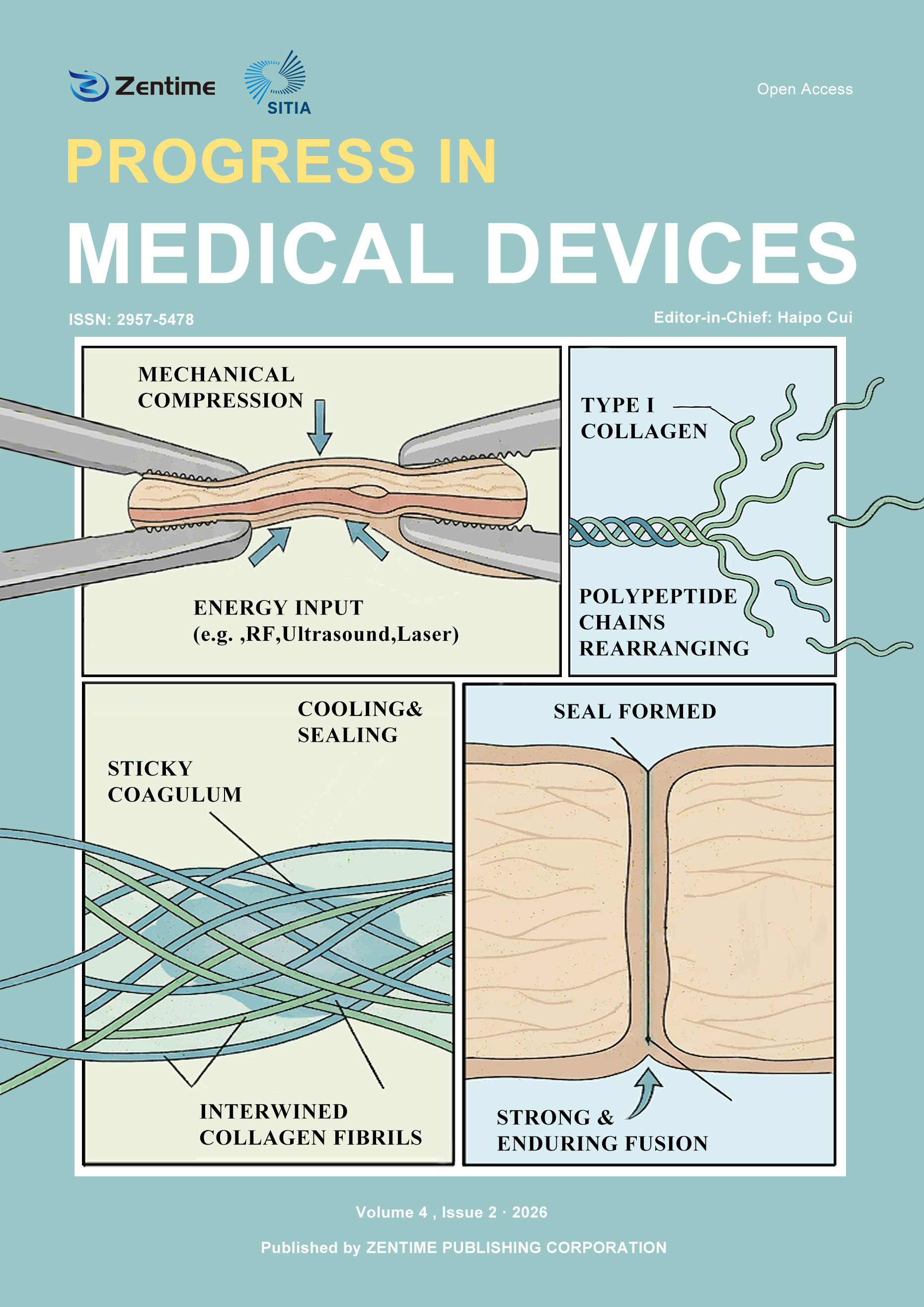
linmao@usst.edu.cn Traditional methods of tissue closure, such as sutures and staples, have long been the gold standard in surgery. However, they have major drawbacks, such as the body's reaction to foreign materials and the difficulty of the technical aspects of minimally invasive procedures. Energy-based tissue fusion (EBTF) technology is a revolutionary alternative that uses energy to produce autologous tissue sealing. This review aims to provide a comprehensive analysis of the biophysical principles, technological evolution, and clinical applications of current EBTF technologies and related devices. The fundamental mechanisms of EBTF technologies are investigated, with a focus on collagen denaturation and cross-linking induced by different energy modalities such as radiofrequency (RF) current, ultrasound, and laser. Three representative systems are critically evaluated: the impedance-controlled bipolar system (LigaSureTM), the ultrasonic coagulating shears (HarmonicTM), and the hybrid ultrasonic-bipolar device (ThunderbeatTM). Their performance is compared in terms of vessel sealing efficacy, thermal spread, operative time, and complication rates across various surgical specialties. The clinical evidence indicates that the primary advantage of RF device lies in safety, whereas the ultrasonic devices offer reduced lateral thermal damage, and the hybrid device demonstrate superior versatility and procedural speed. The review concludes by identifying future trends, including the integration of artificial intelligence and robotic platforms, which promise to further enhance the safety and precision of surgical energy devices.
Open Access
lpdbyusst@163.com Objective: Tiny metallic foreign bodies may remain in the human body after accidental ingestion, surgery, or ballistic injury, potentially causing inflammation, tissue damage, and other complications. Although X-ray and CT are widely used for detection and localization, intraoperative motion and workflow constraints may reduce localization accuracy and real-time retrieval efficiency. This study aims to develop a portable multi-frequency electromagnetic excitation circuit to assist the detection and localization of tiny metallic foreign bodies in the human body. Methods: A multi-frequency electromagnetic excitation circuit was designed for balanced-coil eddy-current sensing. The proposed transmitter combines Selective Harmonic Elimination Pulse-Width Modulation (SHE-PWM) with a full-bridge Class-D power amplifier to generate synchronous multi-frequency excitation currents at 50 kHz, 150 kHz, 350 kHz, and 850 kHz. The use of multiple excitation frequencies provides complementary depth sensitivity, in which low-frequency excitation improves penetration depth for deeply embedded targets, while high-frequency excitation enhances the response and spatial resolution of small or superficial objects. Circuit simulations and hardware measurements were conducted to evaluate the time-domain and frequency-domain characteristics of the proposed circuit. Results: Simulation and experimental results showed good agreement with theoretical predictions. The proposed circuit successfully generated synchronous multi-frequency excitation currents with controllable spectral components. The results confirmed that the combination of SHE-PWM and a full-bridge Class-D power amplifier can provide spectrally controllable and energy-efficient excitation suitable for balanced-coil eddy-current sensing. Conclusions: The proposed multi-frequency electromagnetic excitation circuit provides a feasible supplementary solution for tiny metallic foreign-body detection and localization. Its low-cost, portable, and energy-efficient characteristics make it potentially suitable for bedside and intraoperative electromagnetic assistance, especially in scenarios where conventional imaging methods are limited by workflow constraints or real-time localization requirements.
Open Access
guoxd@usst.edu.cn The treatment of prostate cancer (PCa) is shifting towards the use of highly accurate image-guided procedures in order to achieve better oncologic results. A common strategy consists of using both pre-operative multiparametric magnetic resonance imaging and intra-operative transrectal ultrasound during a prostate biopsy or focal ablation procedure, thus offering enhanced localisation information through high spatial resolution and dynamic response, respectively. However, reliable non-rigid registration is still technically challenging owing to differences in cross-modal imaging physics as well as large deformations between the two modalities caused by rectal probe compression; this paper reviews how deep learning has evolved, focusing on convolutional neural networks, generative models, including generative adversarial networks and diffusion models, and transformer-based architectures. We discuss the extent to which they utilise biomechanical priors to inform the solution of registration problems, against standardized challenges such as µ-RegPro. State-of-the-art approaches achieve sub-millimetre target registration errors with real-time inference times for intra-operative deployment. Addressing outstanding challenges related to interpretation and generalization, this review provides an outlook of the road map to develop "physics-aware" smart interventional systems. All these developments represent important steps toward a fully automated, precise, and minimally invasive PCa management pipeline.


 PDFs
PDFs

 CITE
CITE