 Log In
Search




 Open Access
 zouzui@smmu.edu.cnOpen Accesszouzui@smmu.edu.cn
With the evolution of traditional direct laryngoscopes into video-assisted laryngoscopes, the viewing angle provided by video laryngoscopes has been substantially enlarged, enabling more intuitive and clearer visualization of pharyngeal structures and the glottis. However, the design of video laryngoscopes generally retains the relatively bulky blade carrier of traditional direct laryngoscopes. During routine use, this design may still limit the field of view, necessitating significant jaw elevation to obtain a clear view [1, 2]. To address this limitation, our team developed a slim exquisite easy-exposing video laryngoscope (SEE-VL), a slender and refined device designed to facilitate easier glottic visualization (Registration Certificate No.: Su Xie Zhun 20252082044).
The most significant difference between SEE-VL and traditional video laryngoscopes (e.g., UESCOPE® video laryngoscope) lies in the optimized cross-sectional design of blade carrier. While ensuring adequate exposure of the laryngeal structures, SEE-VL minimizes additional trauma to the oral cavity and larynx, providing more intraoral space for establishing an artificial airway. Additionally, SEE-VL is equipped with a high-resolution display, enabling clearer visualization of the laryngeal structures and glottis (Figure 1).

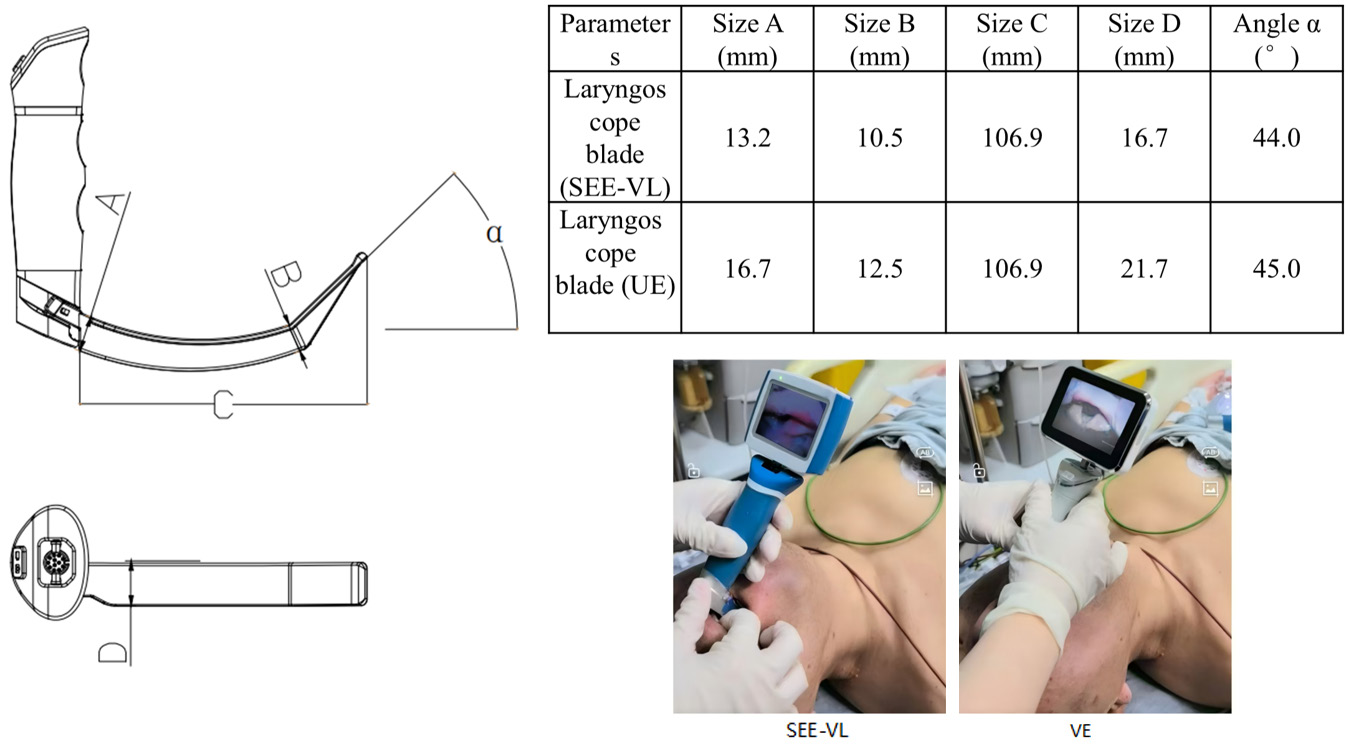
Figure 1. Schematic diagram of the bade carrier in the SEE-VL and its comparison with a conventional video laryngoscope (UESCOPE®video laryngoscope). SEE-VL, Slim Exquisite Easy-exposing Video Laryngoscope.
Author contributions
Zui Zou conceived the study, and Chenglong Zhu draft the manuscript.
Funding
This research received no external funding.
Data availability
Not applicable.
Ethics approval and consent to participate
Not applicable.
Consent for publication
Not applicable.
Competing interests
The authors declare that they have no competing interests.
Acknowledgements
Not applicable.
[1] Sulser S, Ubmann D, Schlaepfer M, Bruesch M, Goliasch G, Seifert B, et al. C- MAC videolaryngoscope compared with direct laryngoscopy for rapid sequence intubation in an emergency department: A randomised clinical trial. Eur J Anaesthesiol. 2016 Dec;33(12):943- 948. https://doi.org/10.1097/EJA.0000000000000525
[2] Mazzinari G, Rovira L, Henao L, Ortega J, Casasempère A, Fernandez Y, et al. Effect of dynamic versus stylet- guided intubation on first- attempt success in difficult airways undergoing glidescope laryngoscopy: A randomized controlled trial. Anesth Analg. 2019 Jun;128(6):1264-1271. https://doi.org/10.1213/ANE.0000000000004102ISSN: 2957-5478
Volume 4, Issue 1
March 2026
Pages: 1-76


 Log In

 On This Page
 CITE
CITE