 Log In
Search




 Open Access
 weilimin19860914@163.com
w.wang.mk@juntendo.ac.jp
weilimin19860914@163.com
w.wang.mk@juntendo.ac.jpLimin Wei, Liaocheng People's Hospital, No. 67 Dongchang West Road, Dongchangfu District, Liaocheng 252000, Shandong, China. E-mail: weilimin19860914@163.com. Wenyi Wang, Juntendo University, 2-1-1 Hongo, Bunkyo-ku, Tokyo 113-8421, Japan. E-mail: w.wang.mk@juntendo.ac.jp.
Received December 10, 2025; Accepted February 28, 2026; Published March 31, 2026
Open Accessweilimin19860914@163.comw.wang.mk@juntendo.ac.jpLimin Wei, Liaocheng People's Hospital, No. 67 Dongchang West Road, Dongchangfu District, Liaocheng 252000, Shandong, China. E-mail: weilimin19860914@163.com. Wenyi Wang, Juntendo University, 2-1-1 Hongo, Bunkyo-ku, Tokyo 113-8421, Japan. E-mail: w.wang.mk@juntendo.ac.jp.
Received December 10, 2025; Accepted February 28, 2026; Published March 31, 2026
Obstetric and perinatal anesthesia, while crucial for maternal and neonatal health, carries inherent risks that necessitate careful management and resource optimization to ensure patient safety. Improvements in anesthesia methods, ultrasound-assisted blocks, multimodal analgesia and accelerated rehabilitation protocols have enabled individualized and precise control of postoperative pain to be achieved more readily. Risk analysis, dynamic observation, and personalized intervention can all significantly lower the rates of hypotension, nausea and vomiting, and nerve injury. International practice variations highlight how resource availability—including staffing levels and expertise—and adherence to clinical guidelines profoundly impact maternal and neonatal outcomes, underscoring that scientific resource optimization is essential for ensuring safety and enhancing efficiency. This perspective discusses the current trends in perinatal anesthesia, focusing on risk minimization and resource utilization. By synthesizing recent advancements and practice variations, we aim to offer a conceptual framework and valuable insights for clinicians making management decisions.
Keywords: Perinatal anesthesia, Regional analgesia, Risk management, Resource optimization, Maternal and neonatal safety, Multimodal analgesia
Perinatal and obstetric anesthesia is an important part of contemporary medicine that directly affects the health of mother and neonates as well as perioperative management. While often used interchangeably with obstetric anesthesia, perinatal anesthesia specifically emphasizes the continuous care spectrum affecting both the mother and the neonate immediately before, during, and after delivery, highlighting the unique physiological and safety considerations for this dyad. Over the past several decades, anesthetic practice has evolved from being experience-based to a scientific, evidence-supported, personalized, and multidisciplinary model. All techniques, including ultrasound-guided anesthesia and epidural anesthesia, are now performed by experienced clinicians, with efficacy evaluated using key performance indicators such as first-attempt success rates, the number of puncture attempts, procedure duration, and patient satisfaction scores. Simultaneously, safety is assessed by monitoring adverse events like vascular puncture or sensory deficits [1, 2].
In recent years, individualized postoperative pain management has become a reality through the optimization of low-dose medications, selective use of regional anesthesia, ultrasound-guided nerve blocks, multimodal analgesia approaches, and the integration of patient-controlled analgesic devices into enhanced recovery protocols. However, while recent reviews have expertly detailed advances in neuraxial techniques or Enhanced Recovery After Surgery protocols, the unique focus of this perspective is to synthesize the symbiotic relationship between risk management and resource optimization, arguing that the latter is the foundational enabler of the former. We aim to offer a conceptual framework and valuable insights for clinicians making management decisions.
2.1 Innovations and applications in anesthesia technology
Advances in technology and pharmacology have been pivotal in improving maternal and neonatal safety and in providing pain relief. For instance, adjunctive measures like preoperative oral carbohydrates have been shown to significantly reduce patients' thirst, hunger, and anxiety, contributing to overall comfort and facilitating postoperative recovery [3]. The precise application of regional anesthesia techniques (epidural, spinal, and combined spinal-epidural) and the development of low-dose drug protocols have helped to minimize the potential side effects associated with general anesthesia. The integration of ultrasound in the implementation of nerve blocks has demonstrably increased both procedural safety and success rates.
Furthermore, the emergence of multimodal analgesia regimens, patient-controlled analgesia (PCA), and enhanced recovery programs has allowed for the better individualization of postoperative pain management (Supplementary Table 1). The table presents an overview of the most commonly used anesthesia techniques as well as special considerations dependent on anesthesia type pertaining to the perioperative period, such as regional anesthesia, low-dose drug regimens, and applications of ultrasound-guided nerve blocks. This forms a solid basis for updating perinatal anesthesia practice. Lessons from the SARS-CoV-2 pandemic have also underscored the value of neuraxial anesthesia in minimizing aerosol-generating procedures, highlighting its critical role in pandemic preparedness protocols for future public health crises [4].
2.2 Global practice variations
Significant global disparities exist in perinatal anesthesia practice, driven by differences in resource availability, staffing levels and expertise, clinical guidelines, and institutional culture. In high-income settings, interventions such as low-dose spinal anesthesia combined with epidurals and PCA pumps are common, intended to maximize maternal hemodynamic stability and minimize adverse neonatal events. Conversely, resource-limited settings are often constrained by a lack of equipment, drugs, and trained personnel. In some regions, a high cesarean section rate is ascribed not only to clinical indications but also to sociocultural factors, such as fear of labor, in conjunction with a shortage of anesthesiologists that makes epidural anesthesia a less available option [5]. As demonstrated by quality improvement projects, standardization of care and targeted interventions can lead to a consistent decrease in maternal and neonatal mortality, underscoring the impact of systematic approaches [6]. Acknowledging these global differences is essential for developing tailored risk management strategies and optimizing resource allocation to promote more balanced and equitable development in perinatal anesthesia worldwide.
3.1 Risk assessment tools and methods
Systematic risk assessment is essential to guarantee maternal and neonatal safety. An effective risk management workflow begins with a proactive preoperative assessment, using systematic tools to stratify patient risk. For instance, validated scoring systems can identify parturients at high risk for complications like hypotension or nausea. Advanced methods, such as machine-learning models (e.g., MLPIAAR), can further refine these predictions, guiding personalized drug and dosage selection even before the procedure begins. Mathematical models have also been employed to define optimal pump settings for programmed intermittent epidural bolus to enhance efficacy and safety [7]. This initial step sets the foundation for a tailored anesthetic plan. Evidence also guides the selection of adjuncts; for example, dexamethasone and flurbiprofen axetil can decrease the incidence of postoperative vomiting, whereas hydromorphone PCA may increase it [8]. The integration of electronic medical records and artificial intelligence-based dynamic monitoring further enables these strategies to be optimized in real-time.
3.2 Preventive measures and response strategies
Risk management extends into the operating room with a system of "triggers and responses" based on continuous monitoring. Predefined changes in maternal hemodynamics, fetal heart rate, or anesthetic depth (the trigger) should automatically initiate a protocolized response, such as a fluid bolus or vasopressor administration. This proactive approach ensures timely intervention based on objective quality metrics rather than delayed clinical signs. A primary risk during neuraxial anesthesia is maternal hypotension, which can impair uteroplacental perfusion. Pharmacological prevention is therefore a key component of risk management. Evidence from clinical studies suggests that a prophylactic infusion of methoxamine (2.00 μg/kg/min) is as effective as norepinephrine (0.10 μg/kg/min) in maintaining maternal hemodynamics without adversely affecting neonatal outcomes in low-risk parturients [9]. In contrast, other studies have found that certain interventions, like two doses of ondansetron, apparently did not prevent hypotension during cesarean section under ropivacaine epidural anesthesia [10]. Meanwhile, perineal ultrasound measurements have revealed that epidural analgesia has no significant impact on early postpartum pelvic floor function, providing an objective tool for evaluating labor progress and guiding anesthetic application safely [11].
3.3 Recent advances in postoperative complication management
The treatment of postoperative complications has moved from being purely experience-based to an evidence-based, patient-specific standard of care. The early recognition of high-risk factors, introduction of protocolized care pathways, administration of multimodal analgesia, and comprehensive monitoring can significantly lower the occurrence of hypotension, nausea, vomiting, and neurological damage. This evidence-based approach also informs de-implementation of ineffective practices. For example, studies have demonstrated that higher doses of antibiotics do not significantly reduce cesarean section surgical site infection rates, nor does skin preparation with azithromycin reduce them [12, 13]. This paper introduces a conceptual framework for perioperative risk management that spans the entire process, from preoperative assessment to postoperative care (Figure 1). This framework integrates risk prediction models, individualized drug regulation, early warning systems, and robust education and training to systemically promote safety for both mothers and neonates.

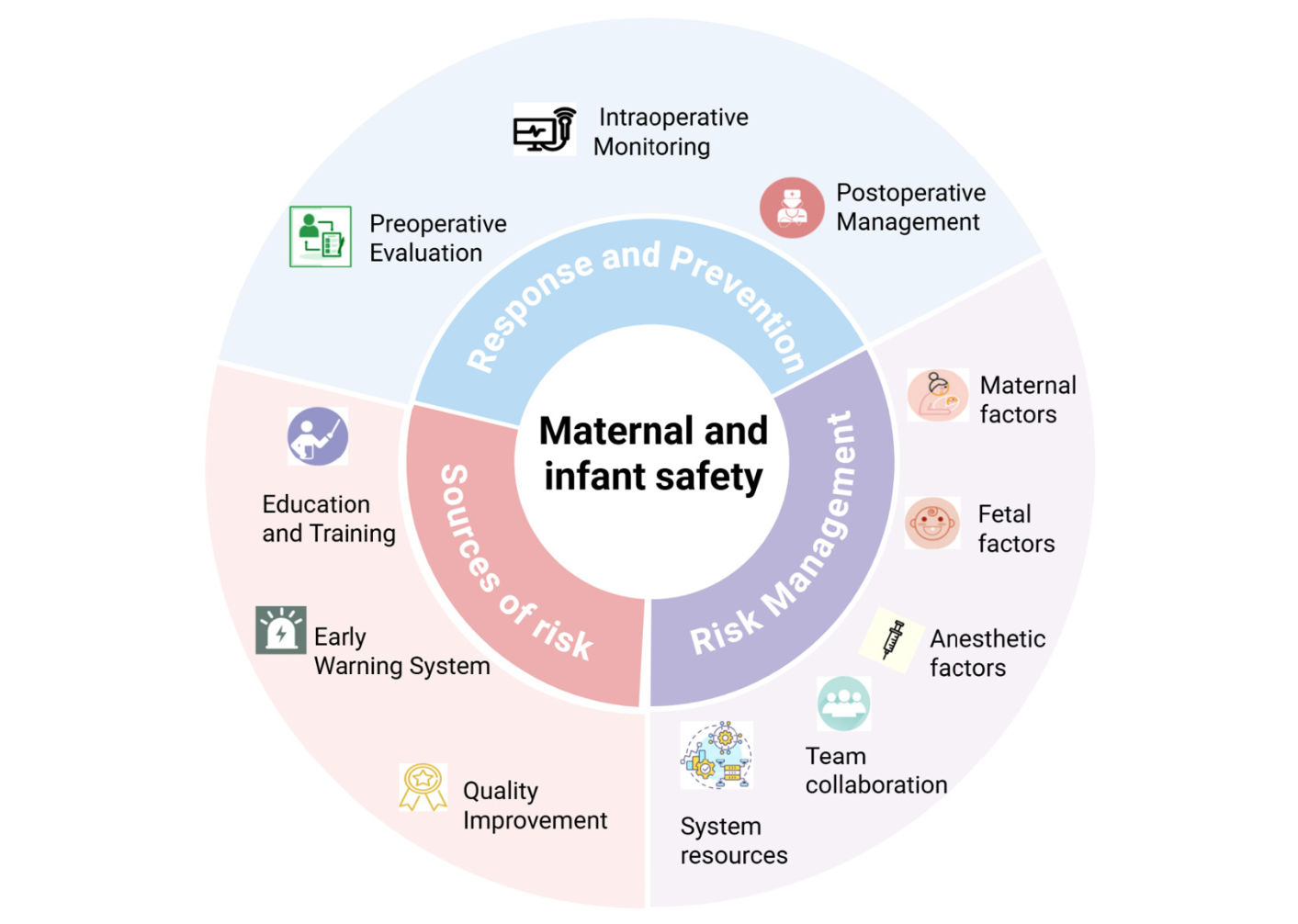
Figure 1. Perioperative risk management framework. This figure provides a structured overview of the fundamental components of perioperative risk management. It is composed of three key clinical process phases—preoperative planning, intraoperative execution and postoperative management—and incorporates comprehensive supports including education and training, an early warning system and team cooperation. The framework is designed to minimize maternal and neonatal harm by increasing quality of care through recognition of internal and external risk factors (e.g., anesthesia-specific, systems-based).
4.1 Rational allocation of human resources
The logical and rational deployment of human resources is critical to maintaining maternal and neonatal safety with high efficiency. Anesthesiologists, midwives, and nurses should be assigned according to the type of surgery, level of anesthesia complexity, and patient risk profile. Creating flexible teams through layered management systems and rotation schemes ensures both routine and emergency support. For example, professional societies like the American Society of Anesthesiologists recommend staffing models that ensure the immediate availability of a dedicated anesthesia provider for every labor and delivery unit. The critical role of providers like certified registered nurse anesthetists in underserved areas exemplifies how professional autonomy can improve access to obstetric services where provider shortages exist [14]. Furthermore, regular interdisciplinary simulation training focusing on high-stakes scenarios (e.g., maternal hemorrhage, neonatal resuscitation) is essential for improving team coordination and readiness.
4.2 Integration of equipment and technological resources
Optimizing the use of equipment is crucial. For example, preoperative handheld ultrasound application can remarkably improve the first-attempt success rate of labor Combined Spinal-Epidural analgesia, reducing procedure time and improving patient experience. The integration of high-precision monitoring devices, PCA pumps, and information platforms that leverage real-time data analytics facilitates dynamic monitoring and evidence-based clinical decision support for hemodynamics, oxygenation, and anesthetic effect. This leads to an optimal operational flow and boosts the accuracy and traceability of anesthesia management [15].
4.3 Economic benefits and cost control analysis
Economic considerations and cost containment are central to resource management. The smart allocation of anesthesia equipment, drugs, and manpower—combined with clinical strategies like low-dose spinal anesthesia, multimodal analgesia, and PCA pumps—can systematically reduce drug waste, shorten hospital stays, and lower overall costs. This achieves dual clinical and economic benefits. Further efficiencies can be gained by optimizing operating room workflows, for example, ensuring the timely arrival of patients and surgical teams for preoperative assessment and communication has been shown to maximize efficiency. Scientific configuration and rationalization of all resources ensure that economic benefits and clinical quality are both promoted, supporting the sustainable development of perinatal anesthesia.
Advancements in perinatal and obstetric anesthesia have led to significant improvements in maternal safety, neonatal outcomes, and analgesic efficacy, driven by the development of new skills and the promotion of modern perioperative management. This work has critically evaluated technological applications, maternal and fetal outcomes, and resource utilization through the lens of risk quantification. We propose an innovative paradigm that views risk management and resource optimization as inextricably linked. The safe and effective implementation of modern anesthetic techniques, from ultrasound guidance to multimodal analgesia, depends entirely on a robust risk management framework. This framework, in turn, is fundamentally supported—or constrained—by the strategic allocation of human, technological, and economic resources. This synergy is the key to advancing perinatal care, enhancing efficiency, and ensuring the highest standards of safety for both mother and neonate.
MLPIAAR, Machine-learning model for postoperative analgesia and adverse reactions; PCA, Patient-Controlled Analgesia; SARS-CoV-2, Severe Acute Respiratory Syndrome Coronavirus 2.
Author contributions
Dezhi Guo and Jingjing Lu contributed to the manuscript writing and figure preparation. Limin Wei and Wenyi Wang supervised the work. All authors have read and approved the final manuscript.
Funding
This research received no external funding.
Data availability
Data sharing is not applicable to this article, as no datasets were generated or analyzed during the current study. All information is derived from publicly available articles and datasets.
Ethics approval and consent to participate
Not applicable. This manuscript does not contain any studies with human participants or animals performed by any of the authors.
Consent for publication
Not applicable. This manuscript does not include details, images, or videos relating to an individual person.
Competing interests
The authors declare that they have no competing interests.
Acknowledgements
Not applicable.
SUPPLEMENTARY METERIAL
Supplementary Table 1 (PDF, 180KB)
[1] Lawson J, Selvaratnam R. Authors response to letter to the editor regarding ‘perinatal outcomes after regional analgesia during labour’. Aust N Z J Obstet Gynaecol. 2024 Oct;64(5):530. https://doi.org/10.1111/ajo.13827
[2] Tawfik MM, Eldeeb AH. Reply to letter to the editor: Ultrasonography versus palpation for spinal anesthesia in obese parturients undergoing cesarean delivery: A randomized controlled trial. Reg Anesth Pain Med. 2024 May 7;49(5):378. https://doi.org/10.1136/rapm-2023-104824
[3] Ghaffari M, Rezaei M, Zarei M, Yazdani A, Saadati MA. The effect of preoperative oral carbohydrate intake on perioperative well-being in patients undergoing hip and lower extremity orthopedic surgery under spinal anesthesia: A randomized controlled trial. Langenbecks Arch Surg. 2025 Jul 25;410(1):230. https://doi.org/10.1007/s00423-025-03797-3
[4] Coviello A, Vargas M, Marra A, Golino L, Saccone G, Iacovazzo C, et al. Protocols of anesthesia management in parturients with sars-cov-2 infection. Healthcare (Basel). 2022 Mar 12;10(3):520. https://doi.org/10.3390/healthcare10030520
[5] Zhao P, Cai Z, Huang A, Liu C, Li H, Yang S, et al. Why is the labor epidural rate low and cesarean delivery rate high? A survey of chinese perinatal care providers. PLoS One. 2021 May 21;16(5):e0251345. https://doi.org/10.1371/journal.pone.0251345
[6] Ersdal H, Mdoe P, Mduma E, Moshiro R, Guga G, Kvaloy JT, et al. "Safer births bundle of care" implementation and perinatal impact at 30 hospitals in tanzania-halfway evaluation. Children (Basel). 2023 Jan 30;10(2):255. https://doi.org/10.3390/children10020255
[7] Munro A, George RB, Andreou P. An innovative approach to determine programmed intermittent epidural bolus pump settings for labor analgesia: A randomized controlled trial. Anesth Analg. 2024 Sep 1;139(3):545-554. https://doi.org/10.1213/ANE.0000000000006813
[8] Zhang K, Jiao B, Sun J, Zhang X, Zhang G, Li N, et al. Predicting high-risk factors for postoperative inadequate analgesia and adverse reactions in cesarean delivery surgery: A prospective study. Int J Surg. 2025 Jun 1;111(6):3859-3875. https://doi.org/10.1097/JS9.0000000000002354
[9] Sheng Z, Mao J, Mei Z, Liu X, Liu J, Chen G, et al. Effects of prophylactic infusion of equivalent doses of metaraminol and norepinephrine for preventing spinal anesthesia-induced hypotension during cesarean delivery on fetal and maternal outcomes: A dual-center, non-inferiority randomized clinical trial. Int J Surg. 2025 Aug 1;111(8):5280-5287. https://doi.org/10.1097/JS9.0000000000002602
[10] Karachanidi S, Paraskeva A, Theodosopoulou P, Micha G, Staikou C. Effect of ondansetron on maternal hypotension during spinal anesthesia with ropivacaine for cesarean sections: A randomized, double-blind trial. Cureus. 2024 Jul;16(7):e65073. https://doi.org/10.7759/cureus.65073
[11] Lyu X, Zhu L, Zhang W, Chen H. Epidural anesthesia and pelvic floor outcomes in primiparas: A retrospective transperineal ultrasound study. Int Urogynecol J. 2025 Jan;36(1):163-171. https://doi.org/10.1007/s00192-024-06000-1
[12] La Rosa M, Omere C, Redfern T, Abdelwahab M, Spencer N, Villarreal J, et al. The impact of low-dose versus high-dose antibiotic prophylaxis regimens on surgical site infection rates after cesarean delivery. Arch Gynecol Obstet. 2020 Jan;301(1):69-73. https://doi.org/10.1007/s00404-019-05370-y
[13] Ausbeck EB, Jauk VC, Boggess KA, Saade G, Longo S, Esplin S, et al. Skin preparation type and post-cesarean infection with use of adjunctive azithromycin prophylaxis. J Matern Fetal Neonatal Med. 2022 Jul;35(14):2690-2694. https://doi.org/10.1080/14767058.2020.1797665
[14] Anderson BL, Sawyer J, Palmer A, Andrilla CHA, Beeson A. Retaining crnas who provide obstetrics services in rural communities: Results from a national survey. J Rural Health. 2025 Mar;41(2):e70021. https://doi.org/10.1111/jrh.70021
[15] Bae J, Kim Y, Yoo S, Kim JT, Park SK. Handheld ultrasound-assisted versus palpation-guided combined spinal-epidural for labor analgesia: A randomized controlled trial. Sci Rep. 2023 Dec 27;13(1):23009. https://doi.org/10.1038/s41598-023-50407-7
ISSN: 2957-5443
Volume 4, Issue 1
March 2026
Pages: 1-148


 Log In

 On This Page
 CITE
CITE